

The Workforce Behind the Investment
Why People Strategy Matters More Than Most Business Owners Realise When investors discuss entering Tanzania, the conversation usually begins with the market. How large is the opportunity? What l
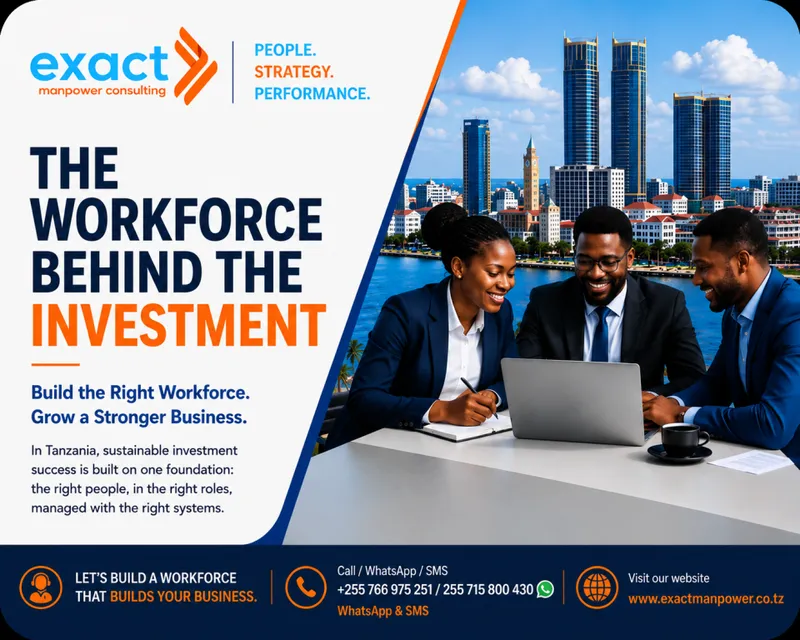
Why People Strategy Matters More Than Most Business Owners Realise
When investors discuss entering Tanzania, the conversation usually begins with the market.
How large is the opportunity? What licences are required? What will the tax structure look like? Where should the business be located? How much capital is needed? Who are the customers? How will the supply chain work?
Those are all legitimate questions.
But there is another question that often comes too late:
Who is actually going to run the business?
That question sounds simple. It is not.
For most businesses, strategy is executed through people. Employees operate machinery, manage customers, sell products, supervise operations, manage money, protect assets, maintain systems, deliver projects and represent the organisation in the market.
A company may have good capital, modern equipment, strong products and an attractive market opportunity. But if the workforce is poorly structured, badly managed or incorrectly costed, the commercial potential of the investment can quickly be weakened.
The better starting point is therefore not:
How many employees do we need?
It is:
What workforce will make this business work, what will it cost, and how should it be managed?
That is a business question before it is an HR question.
Start With the Business Model, Then Design the Workforce
Many organisations recruit first and organise later.
That usually creates avoidable cost.
A better approach is to begin with the operating model.
Which functions are core to the business?
Which capabilities must remain in-house?
Which activities can be outsourced?
Which positions genuinely need permanent employees?
Where would temporary staffing make commercial sense?
Where is specialist external expertise more efficient?
Where will expatriates be needed during start-up, technology transfer or commissioning?
A modern workforce does not need to consist entirely of permanent employees.
Depending on the business, the right structure may combine permanent staff, outsourced manpower, specialists, contractors, temporary employees, expatriates and external service providers.
Each model gives management a different mix of:
Cost, control, flexibility, skills, continuity and scalability.The strongest businesses do not simply employ people because “that position has always existed.”
They continually ask:
What is the most effective way to get this work done?
That is workforce strategy.
And while Tanzania's employment framework sets the boundaries within which these arrangements operate, the commercial decision still belongs to management.
Headcount Can Be Misleading
A company may proudly say it employs 500 people.
That number tells us almost nothing about the quality of the business.
Five hundred employees may represent productive capacity.
Or they may represent a large fixed cost that management has never seriously examined.
Headcount should therefore never be discussed without productivity and cost.
The same principle applies when approving new positions.
A salary of TZS 2 million per month is not the cost of the position.
The actual economic cost includes salary, employer statutory costs, benefits, leave, overtime, equipment, training, administration and other employment-related expenses.
Management should therefore think in terms of Total Employment Cost.
The better question is not:
Can we afford this employee's salary?
It is:
What will this position really cost the business, and what value should it produce?
That changes the conversation immediately.
It allows management to compare internal hiring with outsourcing, automation, temporary staffing or redesigning the work altogether.
That is workforce economics.
The Minimum Wage Is Also a Pricing Issue
The introduction of the new private-sector minimum-wage framework effective from 1 January 2026 is a good example of why employment matters belong in the boardroom.
The immediate reaction may be:
HR needs to update salaries.
But that is only part of the story.
For a labour-intensive company, a wage adjustment may affect the entire operating model.
It can influence overtime, salary grades, recruitment offers, contractor pricing, outsourced manpower rates and the total cost of production or service delivery.
For an employer with several hundred workers, what appears small at individual level can become material when multiplied across the workforce and annualised.
That is why the real management questions are:
How does the wage movement affect our cost base?
Does it change our pricing assumptions?
Will it compress salary differences between grades?
Will outsourced manpower become more expensive?
Do we need to revisit productivity expectations?
These are Finance, Operations and Commercial questions as much as HR questions.
A serious business models the impact before it reaches payroll.
Payroll Should Be a Management Tool
Payroll is one of the richest sources of operating information in a business.
Yet many companies use it for one purpose only:
Paying employees.
That is a missed opportunity.
A good payroll system should tell management much more.
What is the total workforce cost?
Which departments are driving labour expenditure?
Where is overtime increasing?
How much are allowances costing?
How does payroll compare with budget?
What is the employee cost by project, branch or business unit?
Is headcount growing faster than revenue?
These are management questions.
The statutory requirements around tax, social security and workers' compensation are important, but commercially the greater opportunity is to turn payroll into a source of workforce intelligence.
A CEO should not simply ask:
Was payroll processed successfully?
The more useful question is:
What is payroll telling us about how efficiently this business is using its people?
That is a very different conversation.
Attendance Only Matters If It Tells You Something About Output
The same principle applies to attendance.
In many companies, clock-in systems have become sophisticated while management's use of the information remains basic.
The system can tell you an employee arrived at 7:58 a.m.
That is useful.
But the more important question is:
What happened during the hours that followed?
For factories, warehouses, construction sites, hotels, logistics businesses, security operations and other labour-intensive environments, attendance data should be connected to output.
Management should understand who worked, how many hours were used, how much overtime was authorised, why it was required and what additional output resulted.
If overtime continues to rise while productivity remains flat, the problem is not the attendance system.
It is the operating model.
Working-time rules provide the legal framework, but the commercial opportunity is to turn attendance information into better scheduling, better capacity planning and better productivity decisions.
Leave Is Not Just an Employee Entitlement
Leave is often treated as a private matter between the employee and HR.
But at scale, leave becomes a capacity-planning issue.
Imagine a production department where several critical employees carry large unused leave balances.
Or a sales team where leave approvals are handled informally until too many employees are away during a critical month.
Or a business where management cannot accurately estimate its accumulated leave obligation.
These are operational problems.
A good leave system helps management understand workforce availability, staffing coverage, peak-period requirements and accumulated obligations.
The objective is not to discourage employees from taking leave.
It is to manage entitlement and operational continuity together.
As the organisation grows, informal management becomes increasingly unreliable.
At some point, WhatsApp messages and memory are no longer a system.
Probation Is One of the Cheapest Quality-Control Tools a Business Has
Companies spend money advertising vacancies, interviewing candidates, conducting assessments, negotiating salaries and onboarding employees.
Then many organisations almost stop managing the recruitment decision once the employee starts.
Probation becomes a date in the contract instead of a management process.
That is a mistake.
Probation should answer a straightforward business question:
Did we hire the right person?
Is the employee competent?
Reliable?
Productive?
Adaptable?
Able to learn?
Able to work with others?
Capable of delivering what the role requires?
The process does not need to be complicated.
Expectations should be clear. Performance should be observed. Feedback should be given. A decision should be made.
Confirming an employee simply because nobody managed the probation period properly can turn a recruitment mistake into a long-term operating cost.
Good businesses treat probation as quality control.
Poor Performance Has a Cost, Even When Finance Cannot See It
Underperformance rarely appears as a separate line in the financial statements.
But the cost is real.
A weak employee can reduce output, create errors, consume management time, frustrate customers, force stronger colleagues to compensate and weaken the performance standard of the team.
The damage becomes worse when managers tolerate the problem for months.
Performance management should therefore not be reduced to annual appraisal forms.
The real questions are:
What is expected from this role?
How is performance measured?
What happens when expectations are not met?
What support should management provide?
At what point must a decision be made?
The commercial purpose of performance management is simple:
Convert payroll expenditure into productive output.
That is why performance should be discussed with the same seriousness as sales, production or cost control.
Discipline Is Really About Management Credibility
Every company eventually faces misconduct.
Absenteeism. Negligence. Theft. Fraud. Insubordination. Harassment. Safety violations. Misuse of assets. Conflicts of interest.
The question is not whether these situations will occur.
The question is whether management has the confidence and discipline to deal with them consistently.
The legal framework requires fairness and appropriate process, but the business issue goes deeper.
Employees watch how management responds.
If serious misconduct is ignored, employees notice.
If one manager tolerates behaviour that another manager punishes, employees notice.
If senior employees receive different treatment from junior employees, employees notice.
Discipline therefore communicates something important about the organisation:
What standards actually matter here?
A business with clear rules and consistent management creates stronger accountability.
That supports productivity, integrity and culture.
Discipline is therefore not merely a legal process.
It is part of management credibility.
Exiting Employees Is Part of Running the Business
Business owners sometimes treat termination as an exceptional event.
It is not.
Every organisation has an employee lifecycle.
People join.
People perform.
People develop.
People move.
And eventually, people leave.
Some resign.
Some retire.
Some fail to perform.
Some commit serious misconduct.
Sometimes technology removes the need for a position.
Sometimes business strategy changes.
Sometimes an entire structure needs to be redesigned.
Employment law provides the framework for handling these situations properly.
But from a business perspective, employee exit is an operating process.
A professional separation should deal with handover, system access, company property, final payroll, confidential information, replacement planning and knowledge transfer.
The principle remains simple:
Hire deliberately. Manage consistently. Separate professionally.
How a company exits employees says almost as much about its management quality as how it hires them.
Restructuring Should Not Begin With Names
One of the weakest approaches to restructuring is beginning with a list of employees management wants to remove.
That is not organisation design.
The correct starting point is the future business.
What will the business look like?
What will customers require?
What technology will change?
Which functions will grow?
Which activities will disappear?
What capabilities will be needed?
Only then should management design the organisation required to execute that strategy.
The sequence should be:
Business Strategy → Organisation Design → Required Capabilities → Workforce Structure
Once that is clear, management can determine which positions remain necessary.
This produces much better decisions than beginning with headcount reduction.
A restructuring should ultimately leave the organisation better designed, not merely smaller.
Safety Is Good Operations
In manufacturing, mining, construction, engineering, warehousing, hospitality and logistics, safety is sometimes discussed as though it competes with productivity.
That is a false choice.
The disciplines behind good safety are the same disciplines behind good operations:
Clear procedures.
Training.
Supervision.
Maintenance.
Reporting.
Inspections.
Accountability.
Corrective action.
These systems protect employees, but they also support equipment reliability, production continuity, product quality and insurance performance.
Tanzania's occupational health and safety framework establishes important obligations for employers, but business leaders should see beyond the legal requirement.
A safe operation is usually a better-controlled operation.
Safety belongs inside operational excellence.
Expatriates Should Leave Capability Behind
International investors frequently require foreign expertise.
This may be necessary during market entry, plant commissioning, construction, technology transfer, systems implementation or specialist management assignments.
The mistake is to manage expatriates only as immigration cases.
The more useful business questions are:
What expertise are we purchasing?
Why do we need it?
How long should we need it?
Which Tanzanian employees are learning from it?
What capability should remain when the expatriate eventually leaves?
The best sequence is:
Specialist Need → Expatriate Deployment → Knowledge Transfer → Local Capability → Succession
Work-permit and immigration requirements naturally sit around this process.
But the strategic purpose should be capability development.
A well-managed expatriate should not simply perform a job.
They should strengthen the organisation that remains behind.
Workforce Data Should Help the CEO Make Decisions
Businesses now collect more employee information than ever before.
Payroll systems.
Biometric attendance.
Performance systems.
Recruitment platforms.
Employee records.
Training databases.
Benefits information.
The legal framework around personal-data protection rightly requires organisations to manage this information responsibly.
But business leaders should not stop at protecting data.
They should ask what the information can tell them.
Good workforce data can help identify:
- rising labour cost;
- high turnover;
- critical skills gaps;
- overtime hotspots;
- weak productivity;
- succession gaps;
- compensation inconsistencies;
- absenteeism patterns;
- and future manpower requirements.
The objective should be straightforward:
Use workforce information lawfully, securely and intelligently.That is workforce intelligence.
Policies Matter When the CEO Can No Longer Manage Everything Personally
Small businesses can operate informally for a long time.
The founder knows everyone.
Leave requests come directly to the owner.
Recruitment decisions are personal.
Performance problems are discussed in the corridor.
But growth eventually breaks that model.
Once an organisation reaches a certain size, the business must operate through managers.
That is where policies become important.
A useful policy simply answers:
How do we do this here?
How do we recruit?
How do we approve leave?
How do we reward?
How do we deal with poor performance?
How do we discipline?
How do we handle complaints?
How do we protect information?
How do we manage conflicts of interest?
How do we separate employees?
Well-designed policies convert the founder's expectations into repeatable management practice.
They create consistency without requiring the CEO to personally supervise every people decision.
That is an important step in scaling a business.
When Buying a Business, You Are Buying the Workforce Too
Investors normally examine revenue, assets, debt, tax obligations, licences and contracts before completing an acquisition.
They should examine the workforce with similar seriousness.
The objective is not merely to identify employment problems.
It is to understand the human capability behind the earnings.
An investor should know:
What is the real headcount?
What does the workforce cost?
Which employees are critical?
Which skills are difficult to replace?
How strong is management?
Where are the succession gaps?
How much overtime is being used?
Are compensation levels competitive?
Will key employees remain after the transaction?
How dependent is the business on expatriates?
Are the HR and payroll systems reliable?
Could the organisation be redesigned?
Employment, social-security, workplace-safety, immigration and data-protection requirements naturally form part of that review.
But the central commercial question is:
Do the people and management systems support the investment thesis?
A factory may have excellent machinery.
Without the right people to operate, maintain and manage it, the value of those assets is limited.
The CEO Needs Better Workforce Questions
One of the clearest signs that HR has become a serious business function is the quality of information reaching the CEO.
A useful management dashboard should go beyond headcount.
It should show workforce cost, payroll against budget, overtime, absenteeism, turnover, vacancies, recruitment time, productivity, performance, critical skills, leave utilisation, expatriate status and relevant operating indicators.
But the dashboard itself is not the objective.
The objective is to answer better questions:
Do we have the right people?
Do we have enough people?
Are they productive?
What are they costing us?
Where are we losing capacity?
Which capabilities will we need next?
Can this workforce support growth?
Those are business questions.
And that is where HR starts becoming workforce intelligence rather than administration.
There Is No Single Correct HR Model
Not every company needs a large HR department.
A large manufacturing business may require a substantial internal team.
A growing company may be better served by an internal HR leader supported by outsourced specialists.
A smaller international investor may initially outsource payroll, recruitment and HR administration.
For appropriate market-entry situations, an Employer of Record arrangement may also provide a practical route to deploying an initial local workforce before a full employment infrastructure is developed.
The right decision depends on:
Speed + Control + Capability + Cost + Flexibility + Scale
The mistake is assuming the structure chosen today must remain forever.
The HR model should evolve with the business.
People Are Not Just Cost. They Are Operating Capacity.
The workforce is often one of the largest costs in a business.
That does not make people merely a cost centre.
People are operating capacity.
They produce.
They sell.
They manage.
They innovate.
They supervise.
They solve problems.
They maintain relationships.
They execute projects.
They deliver strategy.
The question for business leaders should therefore not simply be:
How do we reduce employee cost?
The better question is:
How do we generate greater productive value from the workforce we are already paying for?
That requires better organisation design.
Better recruitment.
Better managers.
Better payroll information.
Better performance management.
Better attendance data.
Better capability planning.
Better workforce systems.
And a legal framework that is understood sufficiently to support—not dominate—those decisions.
For businesses operating in Tanzania, the Employment and Labour Relations Act, labour institutions framework, 2025 labour-law amendments, current minimum-wage requirements, occupational health and safety rules, workers' compensation, social-security requirements, immigration rules and personal-data legislation all remain relevant.
They set important parameters.
But they should not become the headline of the business conversation.
The headline should remain:
How do we build and manage a workforce that makes the business perform?
That is the question that should interest the CEO.
And ultimately, that is the question that should interest the investor.
---------------------------------------------------------------------------- How Exact Manpower Consulting Supports Business OperationsExact Manpower Consulting works with business owners, investors and management teams to build workforce systems around the operational needs of the business.
Our work covers workforce planning, organisation reviews, recruitment and executive search, manpower outsourcing, HR outsourcing, Employer of Record services, payroll, compensation benchmarking, performance management, employee relations, restructuring support, expatriate administration, workforce due diligence and HR technology through ExactEHRM.
The starting point is not simply the labour law.
It is the business.
Entering, Growing or Restructuring a Business in Tanzania?
Do not begin with:
How many employees do we need?
Begin with:
What workforce will make this business work?
Then design the structure, cost, systems and management discipline around that answer.
Speak to an Exact HR Consultant about workforce strategy, recruitment, payroll, manpower outsourcing, Employer of Record services and HR operating systems in Tanzania.
----------------------------------------------------------------------------This article is written from a business-management perspective and is informed by Tanzania's current employment, labour, workplace safety, social-security, immigration and personal-data framework. It is not intended as legal advice.